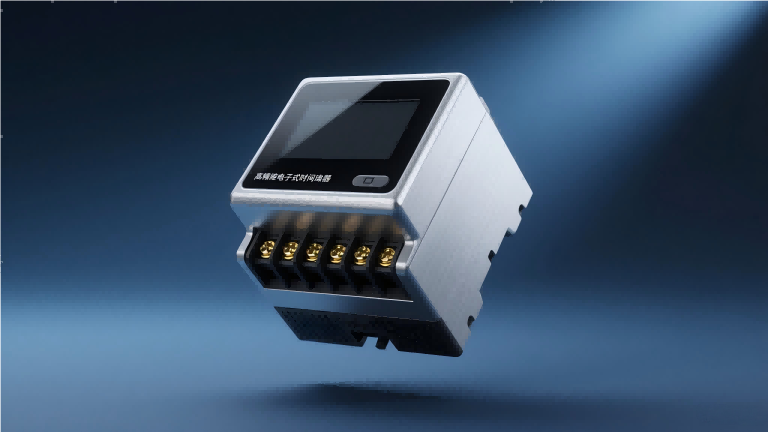
Have you ever wondered why your home washing machine can "automatically power off after washing clothes"? Or why the factory assembly line can "feed materials first and then start stamping after 3 seconds"? Behind these scenarios of "doing things in a time sequence" lies a key component — the time relay. It's not an ordinary "switch" but an "intelligent timer" that enables circuits to "act with a delay". It can be found almost everywhere, from household appliances to industrial equipment. Today, let's talk about this small component that "controls time" from a technical perspective.
Before delving into the technical details, remember the core point: The essence of a time relay is a "delayed switch" — after receiving a start signal, it doesn't act immediately. Instead, it waits for a set time (such as 1 second or 10 minutes) before triggering the circuit to be connected or disconnected.
Take a simple example:
When your home microwave oven "rings after heating is finished", it's actually the time relay inside the microwave oven working. When you set "heating for 2 minutes" and start it, the time relay starts timing. After 2 minutes, it will trigger the "ringing" circuit and cut off the heating circuit at the same time. Without it, the microwave oven would either "ring as soon as it starts" or "not stop after heating is completed", completely out of control.
Looking at an industrial scenario: The reason why a factory elevator "starts 3 seconds after the door closes" is also due to the time relay. After the door-closing signal is triggered, the relay waits for 3 seconds to confirm that the door is closed properly before allowing the elevator to start running, avoiding the risk of pinching people.
In short, the role of a time relay is to "add a 'waiting period' to the circuit so that actions can be carried out in a time sequence, making it safer and more orderly".
The core of a time relay is the "delay mechanism" — this mechanism is responsible for "timing", and after the timing is over, it pushes the "switch contacts" to act. Different types of time relays have different "timing methods". The three most common ones are explained with "lifestyle metaphors":
The principle of this relay is similar to an "old-fashioned pendulum clock", with the core being a "damper" (which can be understood as a "spring with resistance").
When it receives a start signal (such as being powered on), the electromagnet will pull in, but the connecting rod connected to the "switch contacts" will not move immediately — because a "damper" (with oil or air inside) is connected to the connecting rod, and the connecting rod needs to "slowly overcome the resistance of the damper" to move. The time of this "slow movement" is the "delay time" we set.
When the connecting rod moves to the end point, it will push the switch contacts to connect or disconnect, completing the delayed action.
The advantage is its simple structure and resistance to high and low temperatures. The disadvantage is that the delay accuracy is not high (for example, if set to 10 seconds, the actual time may differ by 0.5 seconds), so it is suitable for scenarios with low accuracy requirements (such as elevator door-closing delay).
This is the current mainstream, and its principle is similar to a "mobile phone alarm clock" — relying on an electronic chip (such as a single-chip microcomputer) for precise timing, just like setting a "reminder after 5 minutes" on your mobile phone.
Its core is an "oscillating circuit" (which generates a stable electrical signal, such as generating 1000 pulses per second) and a "counter" (which counts the number of pulses):
- If you set a "delay of 5 seconds", the counter will start counting "5000 pulses" (1000 pulses/second × 5 seconds);
- When the number of pulses reaches 5000, the chip will send a signal to make the contacts of the relay act.
The advantage is extremely high accuracy (if set to 5 seconds, the actual error may only be 0.01 seconds), and the time can also be directly adjusted through buttons or a display screen (from 0.1 second to several hours can be set), suitable for household appliances and precision equipment (such as microwave ovens and printers).
This principle is more intuitive, like "deflating a balloon" — there is an "airbag" and a "small hole" inside, and the airbag is connected to the switch connecting rod.
When powered on, the electromagnet pushes the piston to compress the airbag, and the air in the airbag can only be slowly discharged through the "small hole", so the piston also moves slowly. The time for the air to be discharged is the delay time; when the piston moves to the bottom, it pushes the contacts to act.
If you want to adjust the delay time, you only need to adjust the "size of the small hole": the larger the small hole, the faster the air is discharged, and the shorter the delay; the smaller the small hole, the longer the delay.
The advantage is resistance to vibration and interference, suitable for harsh environments such as factory workshops (such as delayed start of machine tools).
When buying a time relay, you don't need to understand all the parameters in the manual, but these 3 core indicators must be looked at, which are directly related to "whether it can be used and how well it can be used":
It refers to the "shortest delay" to "longest delay" that the relay can set, such as "0.1 second ~ 60 seconds" or "1 minute ~ 24 hours".
When choosing, it is necessary to "match the demand": For example, if a microwave oven needs "10 seconds ~ 30 minutes", you can't choose a relay that "starts from 1 hour"; if the elevator door-closing delay only needs "2~5 seconds", choosing "0.1 second ~ 10 seconds" is sufficient, and choosing a too wide range is a waste.
The contacts of the time relay (equivalent to the "connector of the switch") have two core forms, which should be selected according to the circuit requirements:
- Power-on delay type: Starts timing after power-on, and the "contacts close" after the timing ends (for example, the microwave oven "starts timing after power-on, and closes the 'ringing' circuit when the time is up");
- Power-off delay type: The contacts are always closed when powered on, and start timing only after power-off. The "contacts open" after the timing ends (for example, factory emergency lights: the lights do not turn on when normally powered on, and the time relay starts timing after power-off, and the lights remain on for 30 seconds to facilitate personnel evacuation).
It refers to the "maximum voltage" and "maximum current" that the relay can be connected to, such as "AC 220V", "DC 24V", and "rated current 5A".
This parameter must match the circuit: If the circuit is a 220V household voltage, you can't choose a "DC 12V" relay, otherwise it will burn out as soon as it is powered on; if the relay is to control a "high-power motor" (current 10A), you can't choose a "5A" one, otherwise the contacts will melt due to excessive current.
The application of time relays is far more extensive than you think. Almost all scenarios that require "delayed actions" have its presence:
- Household appliances: Microwave ovens (heating timing), washing machines (delayed dehydration after rinsing), air conditioners (delayed shutdown of fans after shutdown to allow the external unit to dissipate heat);
- Building safety: Emergency lights in stairwells (delayed extinguishing for 30 seconds after power failure), fire doors (delayed closing in case of fire to allow personnel to escape);
- Industrial production: Assembly lines (delayed stamping after feeding), motor start-up (when a large motor starts, it switches to the normal operation mode with a delay to avoid current impact), automatic welding machines (delayed wire feeding to ensure stable welding points).








 English
 Français
 Deutsch
 Português
 Español
 русский
  한국어
한국어 العربية
 Italiano
 Indonesia
 Schweiz
 Polski
 Nederlands
 ישראל - עברית
 Perzisch
 ไทย
ไทย 日本語
日本語 ኢትዮ-አማርኛ
 Việt Nam
 Kiswahili
 Srpski
 Ελληνικά
 简体中文
简体中文