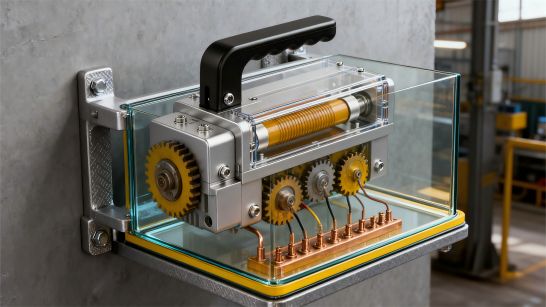
The sequence of low-voltage fuses and low-voltage switches (including
circuit breakers) in a circuit depends primarily on the
core protection objectives of the circuit, the functional positioning of the equipment, and specific application scenarios; it is not absolutely fixed. The design of "connecting the fuse after the air switch" in machine tool distribution boxes is essentially an optimized protection logic tailored to the special power consumption needs of machine tool equipment, rather than a violation of general principles.
Whether in general circuits or machine tool circuits, the underlying logic of sequence design is to "allow different devices to perform their respective functions and avoid functional conflicts or protection failures". The differences in the core functions of the two devices determine the basic sequence framework:
The "fuse first for isolation" and "air switch first in machine tools" that you have observed are essentially differences in requirements between the "general power distribution scenario" and the "equipment-specific power distribution scenario". Details are as follows:
- Applicable Scenarios: Main power distribution circuits requiring "isolation + main protection", such as the main distribution box on a plant floor or the incoming distribution box of a residential building.
- Sequence Logic:
- Priority to Safety Isolation: The fuse is placed first. When the circuit needs maintenance, even if the switch is accidentally closed, the fuse can achieve "physical disconnection" through fusing, preventing electric shock to maintenance personnel (the fuse acts as a partial "isolation knife" in this case).
- Main Protection as a Backup: The circuit breaker is placed behind to provide daily overload and short-circuit protection (resettable, no need for frequent fuse element replacement). It also prevents the "false fusing" of the fuse from affecting the entire circuit (e.g., the circuit breaker trips first during small-current overloads instead of the fuse fusing).
- Applicable Scenarios: "Single-equipment dedicated circuits" such as motors and servo systems of machine tools, e.g., the power supply circuit for the spindle motor of a lathe or the feed motor of a milling machine.
- Sequence Logic (Key Reasons):
- Accurate Equipment Protection: Machine tool equipment is sensitive to current fluctuations, and different components have different rated currents (e.g., 10A for the spindle motor and 2A for the cooling pump motor). The fuse is connected in front of the "equipment", and the fuse element can be accurately matched according to the rated current of the equipment (e.g., a 2A fuse element for the cooling pump circuit). When the equipment has a short circuit, the fuse can fuse quickly, only cutting off the circuit of this equipment without affecting other components of the machine tool (e.g., the spindle motor can still operate normally, avoiding the shutdown of the entire machine tool).
- Reduced Maintenance Costs: The circuit breaker is placed first to handle "total circuit on-off" and "overload early warning" — the circuit breaker is used for daily operations (start-up and shutdown) to avoid frequent plugging and unplugging of the fuse. During small-current overloads, the circuit breaker trips first (resettable), and the fuse only fuses in case of severe short circuits, reducing the frequency of fuse element replacement (replacing fuse elements in machine tool workshops requires shutdown, which affects production efficiency).
- Compliance with Machine Tool Electrical Standards: According to GB 5226.1-2019 Safety of Machinery - Electrical Equipment of Machines - Part 1: General Requirements, "equipment-specific circuits" of machine tools must be equipped with "independent protection devices". The fuse, as "independent short-circuit protection", is connected in front of the equipment, which is a compliant design.
Remember the 3 judgment steps to determine the sequence based on actual scenarios:
- Clarify the Circuit Type: Is it a "main power distribution circuit" (supplying power to multiple devices) or an "equipment-specific circuit" (supplying power to only one device/component)?
- Main power distribution circuit: Prioritize "fuse → circuit breaker" (focus on isolation and total protection).
- Equipment-specific circuit: Prioritize "circuit breaker → fuse" (focus on accurate protection and reduced shutdowns).
- Identify Core Needs: Is the priority "facilitating maintenance isolation" or "accurate equipment protection"?
- For circuits requiring frequent maintenance and involving personal safety: Place the fuse first (isolation first).
- For circuits with sensitive equipment and a need to avoid overall shutdowns: Place the fuse behind (accurate protection first).
- Check Equipment Parameters: The rated current of the circuit breaker should be greater than that of the fuse (to prevent the circuit breaker from tripping before the fuse, rendering the fuse "ineffective"). For example, if the rated current of the circuit breaker is 16A, the fuse element should be 10A/12A (matching the rated current of the backend equipment).








 English
 Français
 Deutsch
 Português
 Español
 русский
  한국어
한국어 العربية
 Italiano
 Indonesia
 Schweiz
 Polski
 Nederlands
 ישראל - עברית
 Perzisch
 ไทย
ไทย 日本語
日本語 ኢትዮ-አማርኛ
 Việt Nam
 Kiswahili
 Srpski
 Ελληνικά
 简体中文
简体中文