





 English
 Français
 Deutsch
 Português
 Español
 русский
  한국어
한국어 العربية
 Italiano
 Indonesia
 Schweiz
 Polski
 Nederlands
 ישראל - עברית
 Perzisch
 ไทย
ไทย 日本語
日本語 ኢትዮ-አማርኛ
 Việt Nam
 Kiswahili
 Srpski
 Ελληνικά
 简体中文
简体中文Intelligent Motor Control – Integration, Optimization, and Future Trends
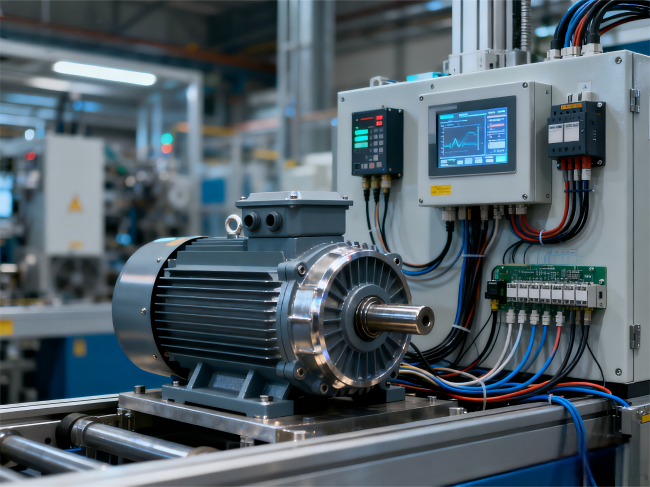
1. Introduction
Motor control has long been the foundation of industrial production. Whether driving pumps, compressors, conveyors, or robotics, electric motors represent over 60% of total industrial power consumption. As automation systems evolve, the demand for intelligent motor control—which combines precision, efficiency, and communication—has never been greater.
Intelligent motor control systems integrate sensors, controllers, frequency converters, and communication modules into a unified platform capable of real-time decision-making. This shift marks the transition from simple control to smart orchestration—where data, algorithms, and hardware collaborate to maximize performance and reliability.
2. The Architecture of Modern Motor Control Systems
A typical intelligent motor control architecture includes three core layers:
-
Power Layer – Drives and protects the motor via power components such as contactors, soft starters, or VFDs.
-
Control Layer – Executes commands using PLCs or microcontrollers that process sensor feedback in real time.
-
Communication Layer – Enables integration with higher-level systems through industrial networks or cloud platforms.
This layered architecture ensures modularity, scalability, and redundancy, allowing engineers to adapt motor systems for diverse industrial environments—from small-scale manufacturing lines to complex process plants.
3. Control Techniques and Algorithms
Advanced control strategies are at the heart of intelligent motor control. These include:
-
Field-Oriented Control (FOC) – Provides high precision by decoupling torque and flux components.
-
Direct Torque Control (DTC) – Achieves faster dynamic response without requiring complex transformations.
-
Sensorless Vector Control – Eliminates the need for physical encoders, reducing cost and maintenance.
-
Adaptive PID and AI-Based Tuning – Enables self-learning optimization under varying load conditions.
These techniques not only improve performance but also support advanced features such as regenerative braking, power factor correction, and torque linearization.
4. Integration with Industrial Communication Networks
The rise of Industrial Ethernet and IoT connectivity has transformed motor control from an isolated process into a data-rich ecosystem. Controllers now communicate directly with supervisory systems via protocols like PROFINET, EtherCAT, and Modbus TCP, allowing end-to-end visibility of performance metrics.
Through this connectivity, engineers can perform condition monitoring, trend analysis, and predictive maintenance. The collected data also feeds into cloud-based analytics tools, where machine learning models can forecast failures, recommend parameter adjustments, or detect inefficiencies before they affect production.
5. Safety, Reliability, and Cybersecurity
As motor control systems become more interconnected, safety and cybersecurity are crucial concerns. Standards such as IEC 61508 and ISO 13849 define safety integrity levels (SIL) for motor control functions including emergency stop, torque off, and overload protection.
In parallel, industrial cybersecurity frameworks must safeguard against unauthorized access and data manipulation. Modern controllers incorporate secure boot, encrypted communication, and role-based access control, ensuring both operational and data integrity.
6. Emerging Technologies: From Edge AI to Digital Twins
The next generation of motor control systems is shaped by three major technological shifts:
-
Edge AI – Embedding machine learning at the controller level to achieve local anomaly detection and self-optimization.
-
Digital Twin Technology – Creating virtual replicas of motor systems to simulate performance, test control logic, and predict failures.
-
Energy Harvesting Sensors – Powering remote condition monitoring devices without wiring or battery replacement.
These technologies redefine how engineers design, commission, and maintain motor-driven systems—ushering in a new era of predictive, autonomous control.
7. Application Fields
Intelligent motor control is widely applied in:
-
Manufacturing Automation – CNC machining, robotics, and conveyor systems.
-
HVAC and Building Management – Smart ventilation, pumping, and chiller optimization.
-
Renewable Energy – Wind and solar tracking systems with adaptive motor control.
-
Water and Waste Management – Flow and pressure optimization in large-scale pumping networks.
-
Process Industries – Chemical, food, and pharmaceutical plants requiring precision and hygiene.
In each case, the objective remains the same: improving energy utilization, process consistency, and equipment uptime.
8. Future Outlook
With the convergence of AI, 5G, and industrial cloud platforms, the future of motor control lies in autonomous optimization. Systems will self-adjust based on environmental inputs, operational priorities, and energy tariffs. Furthermore, sustainability goals will drive the development of carbon-aware algorithms that minimize environmental impact while maintaining performance.
The combination of real-time analytics, digital twins, and advanced motor designs will enable industries to reach unprecedented levels of flexibility and efficiency—paving the way toward the truly autonomous factory.
9. Conclusion
Intelligent motor control represents the evolution of industrial automation from deterministic systems to adaptive, data-driven ecosystems. By combining high-efficiency drives, advanced algorithms, and networked intelligence, modern control architectures deliver not just motion—but insight, prediction, and optimization.
As industries pursue digital transformation, the ability to sense, think, and act at the motor level will define the next frontier of industrial innovation.