





 English
 Français
 Deutsch
 Português
 Español
 русский
  한국어
한국어 العربية
 Italiano
 Indonesia
 Schweiz
 Polski
 Nederlands
 ישראל - עברית
 Perzisch
 ไทย
ไทย 日本語
日本語 ኢትዮ-አማርኛ
 Việt Nam
 Kiswahili
 Srpski
 Ελληνικά
 简体中文
简体中文The Core Role of Frequency Converters in Modern Motor Control Systems
1. Introduction
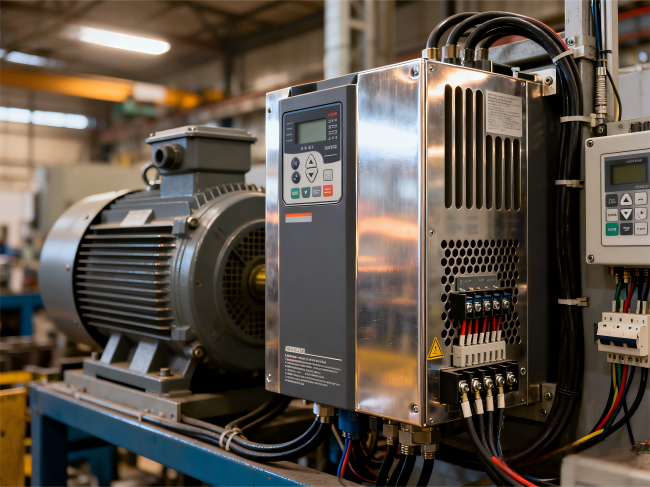
In modern industrial automation, energy efficiency, precision, and reliability have become the core metrics of competitiveness. Among the technologies that directly impact these factors, the frequency converter—commonly known as the Variable Frequency Drive (VFD)—plays an essential role in controlling and optimizing motor performance.
A frequency converter regulates the speed and torque of an AC motor by adjusting the frequency and voltage supplied to it. This not only enhances process control but also significantly reduces power consumption, equipment wear, and system maintenance costs. As industries evolve toward smart and sustainable manufacturing, VFDs have become the backbone of intelligent motor control.
2. Working Principles of Frequency Converters
At its core, a frequency converter operates on three fundamental stages: rectification, DC link filtering, and inverter switching.
-
Rectification Stage – Converts the input AC voltage into DC power through a diode or thyristor bridge.
-
DC Link – Smooths and stabilizes the DC voltage using capacitors and inductors, preparing it for conversion.
-
Inverter Stage – Converts the DC back into an AC output at the desired frequency and voltage using high-speed switching transistors such as IGBTs (Insulated-Gate Bipolar Transistors).
By modulating the pulse width and timing of the inverter output, the drive precisely controls the speed, torque, and direction of the motor. Modern VFDs employ sophisticated control algorithms such as Vector Control and Direct Torque Control (DTC) to achieve high dynamic performance comparable to DC drives.
3. Efficiency and Energy Savings
Energy efficiency remains one of the most significant benefits of applying VFDs. In traditional fixed-speed systems, mechanical throttling or dampers were used to control flow and pressure, wasting substantial amounts of energy. A frequency converter eliminates this inefficiency by reducing motor speed directly according to demand.
Studies show that reducing the motor speed by just 20% can yield up to 50% energy savings. In HVAC systems, water pumps, and conveyor drives, this translates into rapid payback periods and measurable carbon emission reductions. Moreover, soft-starting capabilities minimize inrush current and mechanical stress, extending the lifespan of both the motor and connected mechanical equipment.
4. Control Strategies and Communication Integration
Modern VFDs are more than just power electronics—they are intelligent control units embedded within industrial networks. Integration with PLC, SCADA, and IoT systems enables real-time data acquisition, performance diagnostics, and predictive maintenance.
Key communication protocols include Modbus RTU/TCP, Profibus, CANopen, and EtherNet/IP, which allow seamless connectivity with industrial controllers. Through this integration, operators can monitor energy usage, adjust parameters remotely, and even deploy AI-driven optimization algorithms for load balancing and predictive control.
5. Application Scenarios
The versatility of frequency converters makes them suitable for a wide range of applications:
-
HVAC Systems – Regulating airflow and water circulation in heating and cooling systems.
-
Pumping Stations – Adjusting flow rates to maintain pressure and reduce hydraulic shock.
-
Conveyors and Material Handling – Synchronizing motor speeds for process stability.
-
CNC Machinery – Achieving precise spindle speed control for machining accuracy.
-
Fans and Blowers – Optimizing air delivery while minimizing acoustic noise and vibration.
In renewable energy systems such as wind turbines, converters are used to stabilize voltage and frequency outputs, ensuring grid compatibility and efficiency.
6. Challenges and Future Development
Despite their widespread adoption, VFDs face ongoing challenges in harmonic distortion, electromagnetic interference, and thermal management. Advanced topologies such as Active Front End (AFE) drives and SiC-based power devices are being developed to overcome these issues.
Looking ahead, the integration of edge computing and machine learning algorithms will transform frequency converters into self-optimizing systems capable of adaptive control. These innovations will not only enhance motor efficiency but also enable data-driven maintenance and autonomous fault response—marking a significant leap toward Industry 4.0 and beyond.
7. Conclusion
The frequency converter has evolved from a simple speed controller into an intelligent, connected, and energy-efficient control system at the heart of industrial automation. As industries pursue digital transformation and sustainability, the role of VFDs will continue to expand—bridging the gap between mechanical systems and digital intelligence.