





 English
 Français
 Deutsch
 Português
 Español
 русский
  한국어
한국어 العربية
 Italiano
 Indonesia
 Schweiz
 Polski
 Nederlands
 ישראל - עברית
 Perzisch
 ไทย
ไทย 日本語
日本語 ኢትዮ-አማርኛ
 Việt Nam
 Kiswahili
 Srpski
 Ελληνικά
 简体中文
简体中文The Importance of Industrial Communication Protocols in Drive Control Systems
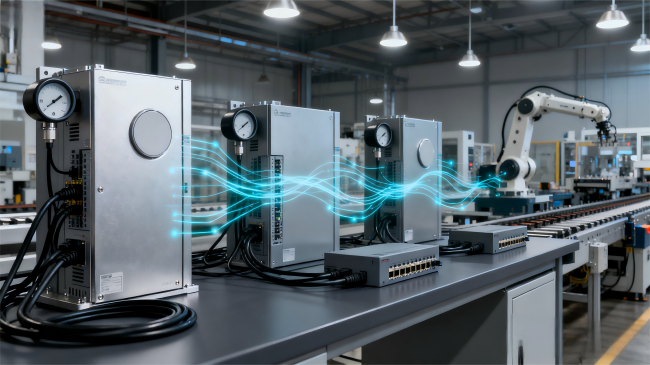
In today’s connected manufacturing environment, industrial communication protocols form the backbone of modern automation. They enable devices to exchange data, integrate seamlessly, and support remote monitoring across global networks. For industrial suppliers serving international customers, understanding and implementing mainstream communication standards is crucial for product compatibility and competitiveness.
1. Why Communication Protocols Matter in Drive Systems
Traditionally, drives operated as standalone units receiving only analog or relay control signals. However, with the rise of Industry 4.0 and the Industrial Internet of Things (IIoT), inter-device communication has become essential. Modern drives must transmit real-time data—such as speed, torque, and temperature—to higher-level controllers. Communication protocols provide the “language” that allows this interoperability.
2. Overview of Common Industrial Protocols
-
Modbus RTU / TCP: Widely used, simple, and cost-effective, but limited in speed and real-time capability. Ideal for small systems.
-
CANopen: Reliable and real-time, suitable for servo and motion control applications.
-
PROFINET / PROFIBUS: Supported by Siemens and common in European automation environments. Offers robust performance for large, complex systems.
-
EtherNet/IP: Based on standard Ethernet, widely used in North America; high compatibility and fast data exchange.
-
EtherCAT: The fastest and most precise real-time protocol, ideal for synchronized multi-axis servo control.
3. Practical Applications in Drive Systems
-
Drives send operational data (current, voltage, fault codes) to PLCs for centralized monitoring.
-
Control systems send commands such as start, stop, and speed reference to drives.
-
Multi-drive networks perform synchronized acceleration or load sharing via master-slave communication.
-
Remote maintenance: engineers can access drives via secure Ethernet to adjust parameters or diagnose faults in overseas plants.
4. How to Choose the Right Protocol
-
Project size and complexity: Small systems can use Modbus; large, real-time systems benefit from EtherCAT or EtherNet/IP.
-
Regional preference: PROFINET dominates Europe, EtherNet/IP is common in North America, and Modbus remains popular in Asia.
-
Integration requirements: Verify that the drive supports standard open protocols and provides documentation in English.
-
Upgradability: Choose drives with firmware-upgradable communication modules to ensure future compatibility.
5. Real-World Example
In an overseas HVAC project, multiple ICX variable frequency drives were networked via EtherNet/IP to a centralized control system. Each drive transmitted real-time power consumption, frequency, and temperature data. The system automatically adjusted fan speeds to balance load and airflow, achieving more than 15% energy savings. The selected drives supported 1 Gb/s interfaces, SNMP alarms, and remote diagnostic capabilities—key factors for long-distance operation and maintenance.
6. Conclusion
Industrial communication protocols are the foundation of intelligent, networked drive systems. For international suppliers, offering products that support mainstream global standards such as EtherCAT, PROFINET, and EtherNet/IP enhances competitiveness and customer trust. By providing technically sound and communication-ready solutions, you position your company at the forefront of the global industrial automation market.