





 English
 Français
 Deutsch
 Português
 Español
 русский
  한국어
한국어 العربية
 Italiano
 Indonesia
 Schweiz
 Polski
 Nederlands
 ישראל - עברית
 Perzisch
 ไทย
ไทย 日本語
日本語 ኢትዮ-አማርኛ
 Việt Nam
 Kiswahili
 Srpski
 Ελληνικά
 简体中文
简体中文The Role and Optimization of Industrial Ethernet in Modern Automation Systems
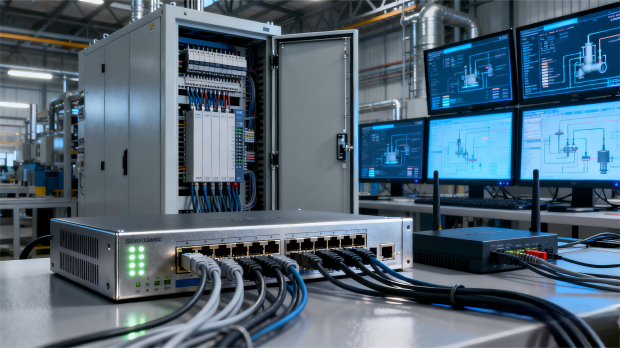
In the field of industrial automation, Industrial Ethernet has become a cornerstone of efficient communication, replacing many traditional fieldbus systems. Its high speed, flexibility, and openness make it an essential part of smart manufacturing and Industry 4.0. For engineers and plant operators, mastering how to deploy and optimize Industrial Ethernet networks is key to ensuring system stability, reducing downtime, and preparing for digital transformation.
1. Why Industrial Ethernet Matters
Traditional communication protocols such as RS-485, CAN, or Modbus RTU once dominated industrial automation. However, as modern production lines become more complex and data-driven, these protocols are no longer fast or flexible enough. Industrial Ethernet, operating at speeds of 100 Mbps to 1 Gbps, offers the bandwidth required for real-time control, large-scale data collection, and remote diagnostics.
Compared to classic fieldbus systems, Industrial Ethernet provides:
-
High-speed data transmission, suitable for vision inspection, robotics, and distributed PLC networks.
-
Flexible topologies — star, ring, or daisy chain — enabling modular production layouts.
-
Scalability and openness, with support for TCP/IP-based communication and interoperability between different brands.
-
Longer communication distances and easier integration with existing IT infrastructure.
These advantages have made Industrial Ethernet the backbone of digital factories, connecting everything from PLCs and HMIs to MES and cloud platforms.
2. Common Industrial Ethernet Protocols
There is no single “universal” Industrial Ethernet protocol — rather, different standards are tailored for different control priorities:
-
PROFINET (Siemens): Emphasizes deterministic performance and real-time control.
-
EtherNet/IP (Allen-Bradley, Rockwell): Focuses on device interoperability and ease of integration.
-
EtherCAT (Beckhoff): Known for microsecond-level synchronization, suitable for motion control.
-
Modbus TCP: Simple, open, and widely used for process data monitoring.
For example, in packaging machinery or SMT assembly lines, EtherCAT is preferred for its precise motion control. Meanwhile, large process plants often adopt PROFINET or EtherNet/IP to ensure compatibility across diverse controllers and instruments.
3. Practical Deployment Tips
To ensure stable operation, engineers should pay attention to:
-
Industrial-grade switches and cables: Standard office Ethernet components cannot withstand factory environments with high EMI or vibration. Use shielded Cat5e/Cat6 cables and switches rated for –40℃ to +75℃.
-
Redundant topology: Implement ring networks (e.g., MRP or DLR) to maintain communication if a single node fails.
-
Network segmentation: Divide control and data networks to prevent broadcast storms and improve cybersecurity.
- Proper grounding and shielding: Reduce signal interference in high-frequency or high-current environments.
4. Integration with Smart Manufacturing
Industrial Ethernet also serves as the foundation for IoT and predictive maintenance. By connecting sensors and controllers to a unified Ethernet backbone, engineers can perform:
-
Real-time monitoring of temperature, vibration, and current.
-
Predictive analysis to prevent unplanned downtime.
-
Cloud-based data visualization for process optimization.
For instance, ICX’s industrial networking solutions have been deployed in HVAC automation and control cabinet manufacturing. Their Ethernet-compatible fans and controllers enable seamless communication and remote diagnostics, reducing maintenance workload by up to 30%.
5. Future Trends
With the rise of TSN (Time-Sensitive Networking), Industrial Ethernet is evolving toward deterministic communication even in mixed IT/OT environments. In the future, we can expect unified, latency-controlled networks capable of handling control, safety, and analytics data in one integrated system — pushing automation toward higher intelligence and reliability.