





 English
 Français
 Deutsch
 Português
 Español
 русский
  한국어
한국어 العربية
 Italiano
 Indonesia
 Schweiz
 Polski
 Nederlands
 ישראל - עברית
 Perzisch
 ไทย
ไทย 日本語
日本語 ኢትዮ-አማርኛ
 Việt Nam
 Kiswahili
 Srpski
 Ελληνικά
 简体中文
简体中文Industrial Power System Stability and Energy-Saving Design Strategies
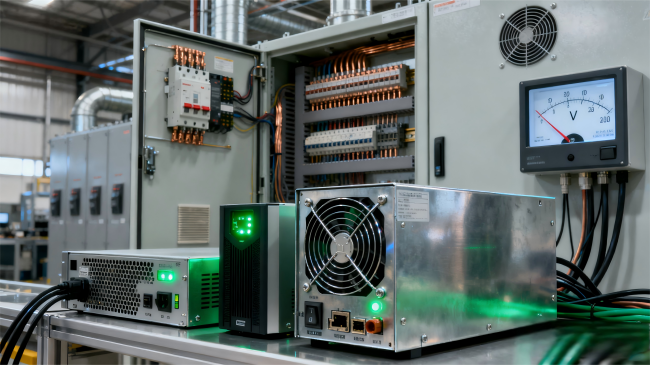
In any industrial automation setup, power stability determines the overall reliability of control systems. A single voltage drop or surge can cause PLC malfunctions, sensor errors, or complete equipment shutdown. Therefore, designing a stable, efficient, and maintainable industrial power system is a fundamental task for electrical and automation engineers.
1. The Core of Industrial Power Design
A typical industrial control cabinet integrates multiple power-consuming components — PLCs, HMIs, frequency inverters, servo drives, and communication modules. Each has unique power requirements in terms of voltage, current, and noise tolerance.
For example:
-
PLC and I/O modules often use 24V DC stable power with ripple ≤1%.
-
Inverters and motors may require 380V AC three-phase with surge suppression.
-
Sensors or analog transmitters need clean DC power to avoid signal distortion.
ICX offers high-efficiency power modules and DC cooling fans that maintain thermal balance, preventing overheating in compact enclosures.
2. Redundancy and Reliability
A robust power design always includes redundant power supplies or UPS backup systems. When one supply fails, another immediately takes over, ensuring continuous operation.
In critical applications — such as semiconductor fabrication or pharmaceutical production — downtime costs can exceed thousands of dollars per minute. Redundant power configurations, combined with proper surge protection, can reduce such risks dramatically.
3. Energy-Saving Design Strategies
Energy efficiency in industrial environments goes beyond saving electricity — it also reduces heat, prolongs equipment life, and minimizes maintenance frequency. Common approaches include:
-
High-efficiency switching power supplies with conversion rates above 90%.
-
Smart load management to shut down idle equipment automatically.
-
Cooling optimization using PWM-controlled fans that adjust airflow based on temperature feedback.
For instance, when using ICX cooling fans with PWM control, airflow can dynamically adapt to cabinet temperature, reducing energy use by up to 25% while maintaining optimal cooling performance.
4. Power Quality and Maintenance
Stable voltage and frequency are critical for automation accuracy. Engineers should regularly monitor parameters such as:
-
Harmonic distortion (THD < 5%)
-
Voltage unbalance (<2%)
-
Ground resistance (<1Ω)
Additionally, proper wiring layout — separating power and signal lines — minimizes electromagnetic interference (EMI). Periodic cleaning of terminals and verifying torque on screw connections prevent contact resistance and heat buildup.
5. Intelligent Power Monitoring
Modern smart factories increasingly integrate power monitoring systems into their control networks. By collecting real-time current, voltage, and energy data, engineers can:
-
Identify abnormal loads before failures occur.
-
Optimize shift-based energy consumption.
-
Track maintenance needs automatically through software alerts.
Integrating such systems via Industrial Ethernet or Modbus TCP allows seamless data flow between power modules, PLCs, and supervisory software — supporting both energy management and predictive maintenance.
6. Toward Green and Reliable Manufacturing
The future of industrial power systems lies in high efficiency, modularization, and digital monitoring. Through advanced designs combining intelligent cooling, renewable integration, and AI-driven load balancing, manufacturers can achieve not only cost reduction but also sustainability compliance.
ICX, as a supplier of industrial fans and electronic components, continuously refines its energy-efficient product line — helping clients around the world maintain reliable operation under challenging industrial conditions.