







 English
 Français
 Deutsch
 Português
 Español
 русский
  한국어
한국어 العربية
 Italiano
 Indonesia
 Schweiz
 Polski
 Nederlands
 ישראל - עברית
 Perzisch
 ไทย
ไทย 日本語
日本語 ኢትዮ-አማርኛ
 Việt Nam
 Kiswahili
 Srpski
 Ελληνικά
 简体中文
简体中文Industrial VFD Selection Guide – The Key to Efficient and Reliable Motor Control
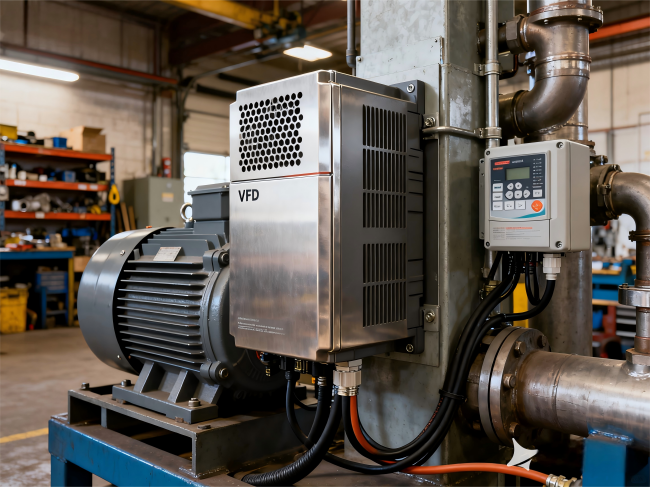
In modern industrial automation systems, the motor drive acts as the core power unit that determines the efficiency, stability, and energy consumption of the entire process. For international projects and engineering contractors, selecting the right Variable Frequency Drive (VFD) is crucial. This article provides a detailed and practical guide to understanding how VFDs work, how to select them correctly, and how to avoid common mistakes during implementation.
1. Why a VFD Matters in Motor Control
A Variable Frequency Drive controls the speed and torque of an AC motor by adjusting the input frequency and voltage. This enables smooth motor control, energy optimization, and system protection.
Key advantages of using a VFD include:
-
Energy efficiency: Adjusts motor speed according to load demand, avoiding unnecessary power waste.
-
Soft start and stop: Reduces mechanical stress and extends equipment lifespan.
-
Improved system response: Especially in vector or closed-loop control systems requiring high dynamic performance.
-
Remote monitoring and integration: Supports digital communication with PLCs and industrial networks.
VFDs are essential components in HVAC systems, water treatment plants, compressors, conveyors, and process industries where variable speed control is critical.
2. Key Parameters for VFD Selection
Selecting a suitable VFD requires more than matching power ratings. The following parameters must be evaluated carefully:
-
Rated power and current: The VFD power rating should slightly exceed that of the motor to ensure margin and thermal stability.
-
Output voltage and frequency range: Match the VFD with the motor’s rated voltage (e.g., 400 V/50 Hz or 480 V/60 Hz).
-
Control mode:
-
V/F Control – Simple and low-cost, suitable for general-purpose loads.
-
Open-loop Vector Control – Offers better dynamic performance for fans or pumps.
-
Closed-loop Vector Control (FOC) – Recommended for high-performance machinery such as CNCs or hoisting systems.
-
Braking and start-up features: Soft start, DC braking, dynamic braking units, or regenerative options should be selected as needed.
-
Communication interfaces: Modbus RTU/TCP, CANopen, EtherNet/IP, or PROFINET are common. Ensure compatibility with your automation network.
-
Environmental protection: Choose IP55 or IP66-rated drives for harsh environments with dust, humidity, or high temperature.
-
Harmonics and power factor correction: High-power systems should use VFDs with built-in filters or active front ends (AFE) to reduce harmonics.
3. Typical Applications and Selection Practices
-
Fans and Pumps: Load varies with flow or pressure. Use standard V/F or open-loop vector control VFDs with PID feedback for automatic speed control—reducing energy consumption by up to 30%.
-
Compressors: Require strong torque and stable acceleration. Select closed-loop vector control with braking or regenerative functions.
-
Machine Tools and CNC Systems: High dynamic accuracy is crucial. Choose high-performance drives with encoder feedback.
-
Conveyors and Winding Systems: Require synchronization and tension control; use multi-axis or servo-type drives.
4. Common Selection Mistakes
-
Only matching power ratings: This ignores control accuracy and load dynamics.
-
Ignoring communication capability: Modern factories require networked drives for remote monitoring and diagnostics.
-
Underestimating environmental conditions: Heat, dust, or humidity can cause premature failure if protection level is insufficient.
-
Insufficient power margin: Drives operating continuously near rated capacity will overheat and fail prematurely.
5. Practical Selection Tips
-
Collaborate with the motor manufacturer and on-site engineers to evaluate real load characteristics.
-
Ensure the chosen drive brand offers strong technical support and a reliable global service network.
-
Select models with CE, UL, or CSA certification for international compliance.
-
Conduct commissioning, training, and remote monitoring tests after installation to verify performance and energy savings.
6. Conclusion
Choosing the right VFD is a critical step in ensuring efficient and stable motor system operation. For export-oriented industrial suppliers, understanding real load requirements, control methods, and system communication needs can greatly enhance project success and customer trust. A properly selected VFD not only optimizes performance but also contributes to long-term energy and maintenance savings.