






 English
 Français
 Deutsch
 Português
 Español
 русский
  한국어
한국어 العربية
 Italiano
 Indonesia
 Schweiz
 Polski
 Nederlands
 ישראל - עברית
 Perzisch
 ไทย
ไทย 日本語
日本語 ኢትዮ-አማርኛ
 Việt Nam
 Kiswahili
 Srpski
 Ελληνικά
 简体中文
简体中文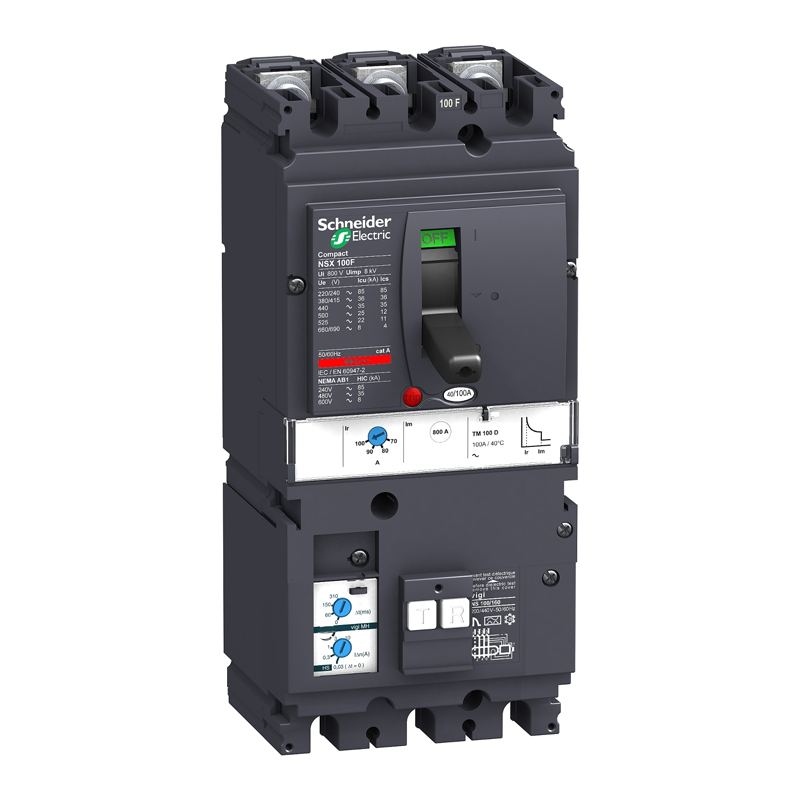
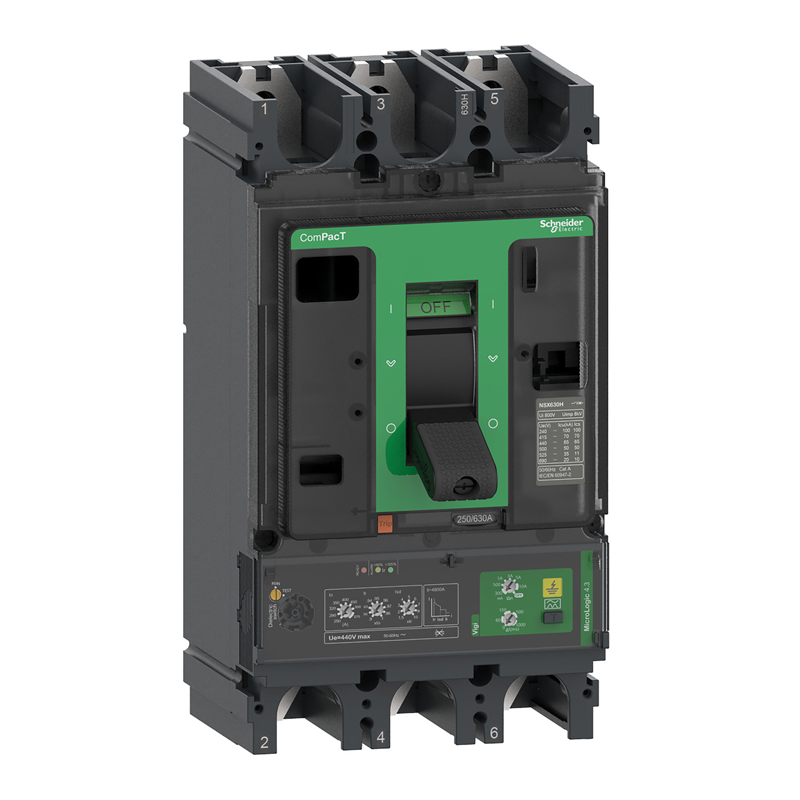
Schneider VIGINSX100F MH TM100D 3P3D (3P) Molded Case Leakage Protection Circuit Breaker
Brand:
Series:
NSX
How It Works:
Manual
Frame Current:
100A
Tripping Mode:
Thermal Magnetic
Protection Function:
LI
Wiring Method:
Front panel wiring
Poles:
3P
Rated Voltage:
380/415VAC
Installation:
Fixed
Trip Unit:
TMD
Rated Current of Release:
100A
Breaking Capacity:
36KA
Model:
VIGINSX100F MH TM100D 3P3D (3P) Fixed front wiring
Order Number:
LV429930
Description:
Schneider molded case leakage protection circuit breaker VIGINSX100F MH TM100D 3P3D (3P) fixed front wiring, fixed, manual, 36KA, 380/415VAC, front wiring, 100A, 3P, frame current 100A
Product parameters
| Product attributes | Attribute value | Filter product attributes |
|---|---|---|
| Brand: | Schneider | |
| Series: | NSX | |
| Appendix: | - | |
| How It Works: | Manual | |
| Frame Current: | 100A | |
| Tripping Mode: | Thermal Magnetic | |
| Protection Function: | LI | |
| Wiring Method: | Front panel wiring | |
| Poles: | 3P | |
| Rated Voltage: | 380/415VAC | |
| Installation: | Fixed | |
| Trip Unit: | TMD | |
| Rated Current of Release: | 100A | |
| Breaking Capacity: | 36KA |
Products with the same attribute : 0
Show details
Series Overview
ComPacT NSX Circuit Breakers and Switch-Disconnectors Overview Outline
Compliance with Standards
● ComPacT NSX circuit breakers and switch-disconnectors comply with the following standards:
● International Standards:
● IEC 60947-1: General rules
● IEC 60947-2: Circuit-breakers
● IEC 60947-3: Switch-disconnectors
● IEC 60947-4-1: Contactors and motor-starters
● IEC 60947-5-1 and following standards: Control circuit devices and switching elements; Electromechanical control circuit devices
● European Standards (EN 60947-1, EN 60947-2, EN 60947-3, EN 60947-5-1)
● China Compulsory Certification (CCC)
● EAC (Customs Union)
● Classification Societies (Bureau Veritas, Lloyd's Register, DNV, etc.)
● Specifications and recommendations from the CNDMO organization for machine tool protection.
Pollution Degree
● ComPacT NSX circuit breakers can operate in environments defined as Pollution Degree 3 by standards IEC 60947-1 and IEC 60664-1 (industrial environments).
Resistance to Damp Heat
● ComPacT NSX circuit breakers have successfully passed tests defined by the following standards for use in extreme atmospheric conditions:
● Dry cold and dry heat:
● IEC 60068-2-1: Dry cold test at -55°C
● IEC 60068-2-2: Dry heat test at +85°C
● Damp heat tests (tropical conditions):
● IEC 60068-2-30: Damp heat, cyclic (55°C, relative humidity: 95%)
● IEC 60068-2-52: Salt mist, severity 2.
Environmental Protection
● ComPacT NSX addresses current environmental protection concerns and complies with the European environmental declaration for electronic products HC/2002/95 (RoHS).
● All ComPacT NSX production plants comply with the ISO 14001 standard. Each plant has detailed production monitoring processes, striving to prevent pollution and reduce the consumption of natural resources.
Ambient Temperature
● ComPacT NSX circuit breakers can operate between -25°C and +70°C. Derating must be considered for temperatures exceeding 40°C (or 65°C for motor protection).
● ComPacT NSX circuit breakers can operate continuously under normal environmental and operating temperature conditions. They can also be stored at temperatures between -50°C and +85°C.
● [1] For ComPacT NSX Micrologic 4.1: -40°C
● [2] For ComPacT NSX: Micrologic control units with LCD screen and Micrologic 4: -40°C
Electromagnetic Compatibility (EMC)
● ComPacT NSX circuit breakers are protected against:
● Overvoltages caused by switching operations (e.g., lighting circuit switching)
● Overvoltages caused by atmospheric disturbances
● Radio wave emitting devices - such as mobile phones, radios, walkie-talkies, radar, etc.
● Electrostatic discharges generated by the user
● ComPacT NSX circuit breaker immunity complies with the following standards:
● IEC/EN 60947-2: Low-voltage switchgear and controlgear, Part 2: Circuit-breakers:
● Appendix F: Immunity tests for circuit-breakers with electronic overcurrent protection
● Appendix B: Immunity tests for circuit-breakers with residual current protection
● IEC/EN 61000-4-2: Electrostatic discharge immunity test
● IEC/EN 61000-4-3: Radiated, radio-frequency, electromagnetic field immunity test
● IEC/EN 61000-4-4: Electrical fast transient/burst immunity test
● IEC/EN 61000-4-5: Surge immunity test
● IEC/EN 61000-4-6: Immunity to conducted disturbances, induced by radio-frequency fields
● IEC/EN 61000-4-8: Power frequency magnetic field immunity test
● IEC/EN 61000-4-11: Voltage dips, short interruptions and voltage variations immunity tests
● CISPR 11: Industrial, scientific and medical (ISM) radio-frequency equipment - Electromagnetic disturbance characteristics - Limits and methods of measurement.
Reliable Contact Indication with Isolation Function
● All ComPacT NSX circuit breakers comply with the definition of isolation in IEC standard 60947-2:
● The isolation position corresponds to the 0 (OFF) position.
● The operating handle can only indicate the "OFF" position if the contacts are genuinely open.
● Padlocking is only possible if the contacts are open.
● The reliability of the contact indication system is not altered by the use of a rotary handle or motor operator [*].
● Tested isolation function must guarantee:
● Mechanical reliability of the contact indication system
● No leakage current
● A certain overvoltage withstand capability between line and load terminals.
● Isolation is only guaranteed when the device is in the OFF position. If the contact indication is displaced, isolation cannot be assured.
Installation in Class III Switchgear
● The front of all ComPacT NSX circuit breakers is Class II insulated. They can be installed in Class I switchgear (according to IEC standards 61140 and 60664-1) without reducing the switchgear's insulation class. This characteristic also applies when the circuit breaker is equipped with a rotary handle or motor operator [*].
Degree of Protection
● Complies with IEC 60529 (IP Code) and IEC 62262 (IK impact resistance rating).
| Breaker Configuration | Degree of Protection |
|---|---|
| Breaker with terminal shrouds | |
| ● With flick handle | IP40 IK07 |
| ● With standard direct rotary handle | IP40 IK07 |
| Breaker installed in switchgear enclosure | |
| ● With flick handle | IP40 IK07 |
| ● With direct rotary handle | |
| ○ Standard / VDE | IP40 IK07 |
| ○ CCM | IP43 IK07 |
| ○ CNOMO | IP54 IK08 |
| ● With extended rotary handle | IP55 IK08 |
| ● With motor operator [*] | IP40 IK07 |
| [*] Does not apply to general-purpose motor operators. |

Rachel
Industrial Control Sales Specialist: Focuses on delivering high-performance, cost-effective industrial control products. Offers end-to-end one-stop procurement support—covering rapid quotation, streamlined order fulfillment, and responsive after-sales service—to simplify clients’ procurement processes.
Email: Anthony@icxsg.com
We offer competitive product pricing. For fast support, send your email, phone, address, and the product model & quantity you want—we’ll reach out quickly!
We typically respond via email within one business day! You can also contact us at Anthony@icxsg.com