




 English
 Français
 Deutsch
 Português
 Español
 русский
  한국어
한국어 العربية
 Italiano
 Indonesia
 Schweiz
 Polski
 Nederlands
 ישראל - עברית
 Perzisch
 ไทย
ไทย 日本語
日本語 ኢትዮ-አማርኛ
 Việt Nam
 Kiswahili
 Srpski
 Ελληνικά
 简体中文
简体中文
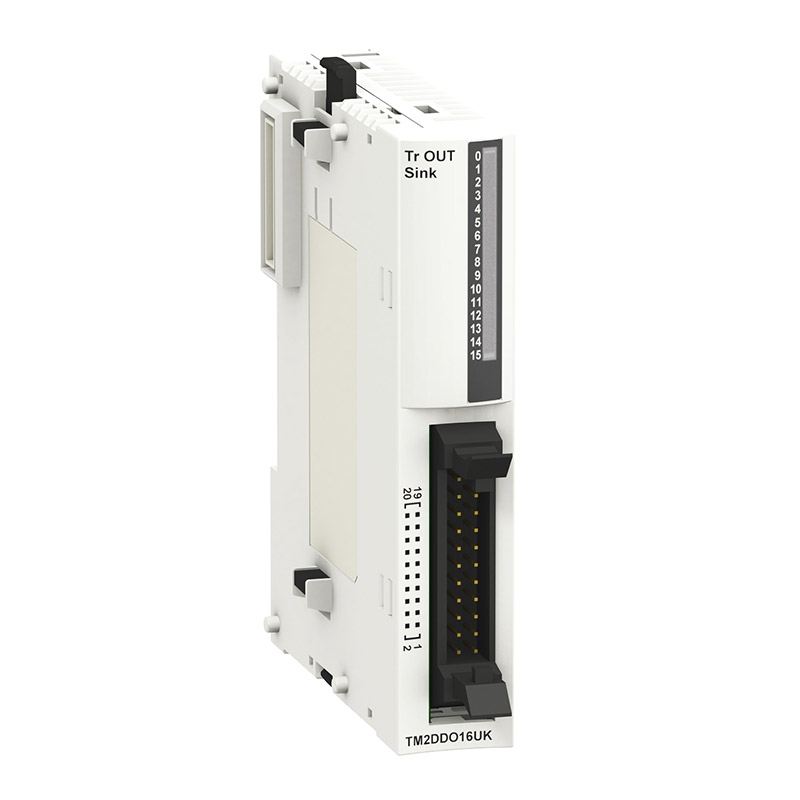
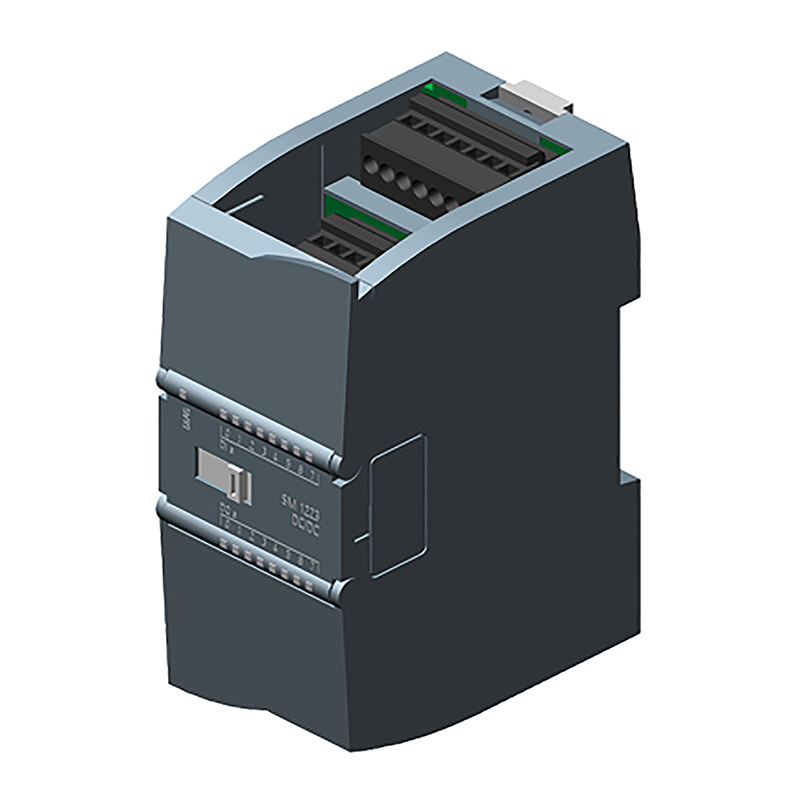
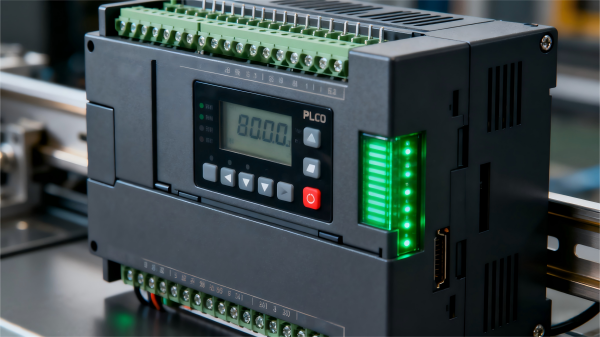
Schneider TM241CE40T PLC Programmable Controller M241
Brand:
Series:
M241
Digital Output Type:
transistor
Digital Input Voltage:
24VDC
Analog Output:
-
Digital Input:
24
Digital Output:
16
Analog Output Type:
-
Analog Input:
-
Analog Input Type:
-
Supply Voltage:
20.4-28.8VDC
Product Type:
Digital Module
Model:
TM241CE40T
Order Number:
TM241CE40T
Description:
Schneider M241 TM241CE40T, power supply voltage 20.4-28.8VDC, digital output 16, digital input 24, digital module
Product parameters
| Product attributes | Attribute value | Filter product attributes |
|---|---|---|
| Brand: | Schneider | |
| Series: | M241 | |
| Digital Output Type: | transistor | |
| Digital Input Voltage: | 24VDC | |
| Analog Output: | - | |
| Digital Input: | 24 | |
| Digital Output: | 16 | |
| Analog Output Type: | - | |
| Analog Input: | - | |
| Analog Input Type: | - | |
| Supply Voltage: | 20.4-28.8VDC | |
| Product Type: | Digital Module |
Products with the same attribute : 0
Show details
Series Overview
Series Overview
Product Features
Modicon M241 Controller Accessories
Memory Card
- A 256 MB capacity TMASD1 SD memory card is used for:
- Application backup, duplication or transfer
- Data logging
- Firmware upgrade
Modicon M241 Controller Expansion Boards
- The front panel of the M241 controller can insert up to two expansion boards at most (depending on the controller model) without expanding the body size.
I/O Expansion Boards
- 3 input or output expansion boards are used for:
- The TMCAAI2 expansion board provides 2 configurable analog inputs for voltage or current signals
- The TMCA AQ2 expansion board provides 2 configurable analog outputs for voltage or current signals
- The TMCAIT2 expansion board provides 2 configurable analog inputs for temperature sensors
Application Expansion Boards
- 2 application expansion boards are used for:
- The TMC4HOISO1 weighing application expansion board has 2 dedicated analog inputs for weighing sensor control
- The MC4PACK01 packaging application expansion board has 2 dedicated analog inputs for temperature control of packaging equipment
- Using the application expansion board, application - specific functions can be accessed through SoMachine V4 software.
Communication Modules
- 2 communication modules are available:
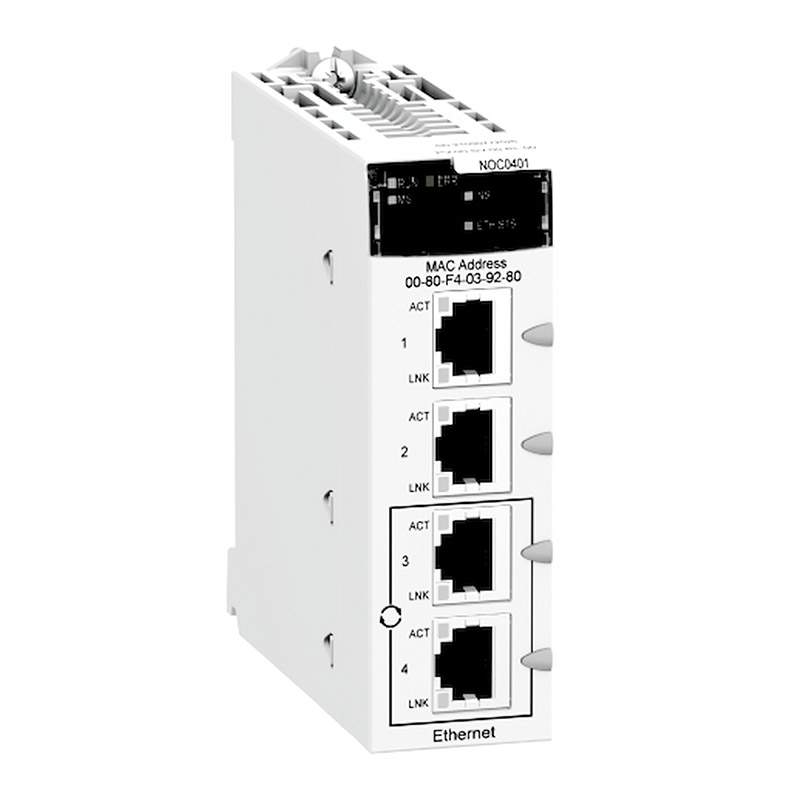
- The TM4ES4 Ethernet switch module: provides a 4 - port Ethernet connection for controllers without a built - in Ethernet communication port
- The TM4PDPS1 Profibus DP slave communication module
- The Modicon TM4 communication module is installed on the left side of the controller using a simple plug - in bracket, and another bus expansion connector is used for distributing data and power supply.
- At most 3 communication modules can be added to the left side of the M241 programmable controller.
Ethernet Switch Module
- The TM4ES4 module is a 4 - port Ethernet interface (10/100 Mbps, MDI/MDIX), supporting the following communication protocols: Modbus TCP (client/server), Ethernet/IP (adapter), UDP, TCP, SNMP and SoMachine.
- After the TM4ES4 module is connected to the M241 controller through the communication bus, this module can be used to provide Ethernet communication functions for the M241C24p and M241C40p controllers without a built - in Ethernet port, and also provides additional functions such as an Ethernet switch.
- When this module is connected to controllers with a built - in Ethernet communication port type, namely TM241CE24pp and TM241CE40..., it becomes an independent switch: the communication between the TM4ES4 module and the Modicon M241 controller is not automatically completed by the bus connector.
Profibus DP Slave Communication Module
- The TM4PDPS1 communication module is used to configure a Profibus DP slave communication connection.
Wireless Bluetooth Communication Connection Settings
- Wireless Bluetooth communication allows free movement within a 10 - meter range around the controller.
- Schneider Electric provides the TCSWAAC13FB wireless Bluetooth communication adapter, which provides a Bluetooth communication solution for the M241 programmable controller and is suitable for transmitting monitoring
Using Modicon TM3 I/O Expansion Modules
Modicon TM3 Expansion Modules
- Utilize the functions provided by Modicon TM3 expansion modules to enhance the performance of the M241 programmable controller:
- Discrete I/O modules can be used to configure up to 264 discrete I/Os. These modules can use the same
Wiring Methods
- Analog I/O modules are used to configure up to 114 analog I/Os, and are also used to receive signals from other sensors, such as position, temperature, speed, etc. In addition, they can control frequency converters or any other devices that provide current or voltage
Devices for Input Signals
- The expert module for controlling TeSys motor starters uses RJ45 communication cables to simplify the integrated wiring of the control area
- The safety function module provides the necessary safety performance for the machine and simplifies wiring, and can be configured in SoMachine V4 software
- In addition, the TM3 expansion system has good flexibility. By using the TM3 bus expansion system, TM3 modules within a 5 - meter range can be remotely connected, such as TM3 modules installed in cabinets or other enclosures.
- The Modicon TM3 expansion system is universally applicable to the overall Modicon M221, M241 and M251 series of programmable controller products. It can support free replacement of controllers without the need to replace expansion modules.
Built - in Communication Functions
- The M241 programmable controller has up to 5 built - in communication ports:
- Two serial communication ports: S11 (RJ45) and SL2 (screw - type terminal blocks), and each controller has a programming port (mini - B type USB)
- Depending on the controller model, there is one Ethernet port (RJ45) or one Ethernet port (RJ45) plus
- One CANopen port
Ethernet Communication
- The TM241CEcpp controller has an Ethernet RJ45 interface (10/100 Mbps, MDI/MDIX), supporting the following communication protocols: Modbus TCP (client/server), Ethernet/IP (adapter), UDP, TCP, SNMP and SoMachine.
- Each M241 controller has a built - in web server and FTP server. Its default address depends on the MAC physical address, and a controller IP address can also be assigned using a DHCP server or BOOTP server. When the controller is powered on, like the programming port (Mini - B type USB), the Ethernet port can also implement functions such as uploading, updating and debugging.
- The firewall is used to filter the IP address of the access controller and define various communication protocols
CANopen Communication
- The TM241CEcpp controller has a CANopen master port. The communication speed can be configured between 20 Kbps and 1 Mbps, supporting up to 63 slave devices.
- CANopen communication framework can be used in distributed I/O modules. Try to be as close as possible to sensors and actuators to reduce wiring costs and wiring time, and also realize communication with different devices, such as frequency converters, servo drives, etc.
- CANopen communication configuration is integrated in SoMachine V4 software, and standard EDS description files can be imported
Serial Communication
- Each M241 controller has 2 built - in serial communication ports.
- The S11 port can be configured as RS 232 or RS 485. In addition, the RJ45 connector uses a 5 V/200 mA power supply, so that Magelis XBTN or XBTRT HMI, TCSWAAC13FB Bluetooth communication adapters or other devices can communicate serially. The configuration is the same as RS485.
- The two built - in communication ports both support the two current mainstream communication protocols:
- Modbus ASCII/RTU master communication or slave communication protocol
- ASCII character string
Programming Port with Power - off Charging Function
- Each M241 controller has a built - in programming port with a Mini - B type USB connector, specially used for communicating with a computer equipped with SoMachine programming software:
- Programming
- Debugging
- Maintenance
- In addition, it can also complete tasks such as uploading application programs or updating firmware when the controller has no external power supply.
Product Features
- Removable screw - type terminal blocks, 3 terminal blocks for connecting 24 Vdc power supply or 100 - 240 V, 50/60 Hz power supply (depending on the controller model).
- The TM241CEcpp controller has an interface (screw - type terminal block) for connecting to the CANopen bus.
- The TM241CEcpp controller has an RJ45 port for connecting to Ethernet communication, with status indicators.
- TM4 bus interface: communication bus for connecting to TM4ppp communication modules.
- SL1 serial communication port (RS 232 or RS 485): RJ45 connector
- SL2 serial communication port (RS485): screw - type terminal block
- 24 V DC discrete input signal connection: removable screw - type terminal block.
- Functions of LED indicators:
- Status of the controller and its components (power supply, SD memory card)
- Status of built - in communication ports (CANopen bus, serial port, Ethernet)
- Status of I/O modules
- TM3 bus interface for connecting to Modicon TM3 expansion modules.
- Removable top cover rear: 11.12, 13, 14, 15
- Run/stop switch.
- SD memory card slot.
- Backup battery slot.
- Mini - B type USB connector for connecting to the programming port.
- I/O expansion boards or application expansion boards: 1 on the TM241C24 controller, 2 on the TM241C40p controller.
- Buckle on the guide rail.
- Relay/transistor discrete output connection: removable screw - type terminal block
Characteristics of M241 Programmable Controller
- Uniformity
- Certified UL compliance: C - Tick, EAC, LR, ABS, DNV, BGL (1)
- Standard: IEC 61131 - 2 (edition 2.2007), UL508 (UL 61010 - 2 - 201), ANSI/ISA 12.12.01 - 2007, CSA C22.2 No. 213, No. 142, EN 61131 - 2, IEC 61131 - 2
- Environmental Characteristics
- Operating ambient temperature: - 10... + 55 °C (+ 14... + 131 °F)
- Storage ambient temperature: - 40... + 70 °C (- 40... + 158 °F)
- Relative humidity: 5... 95% (no condensation)
- Maximum altitude of normal operating environment: 0... 2000 m
- Maximum altitude of storage environment: 0... 3000 m
- Resistance to Mechanical Stress
- Vibration resistance:
- For IEC: 5.8 Hz (amplitude 3.5 mm); 8... 150 Hz (acceleration 1 g)
- For NEMA: 5.8 Hz (amplitude 0.118 in); 8... 150 Hz (acceleration 1 g)
- For transportation: 5... 13.2 Hz (amplitude 1.0 mm); 13.2... 100 Hz (acceleration 0.7 g)
- Vibration resistance:
- Power Supply Characteristics
- Depending on the M241 controller model, the power supply can use: 24 V DC power supply or 100 - 240 V, 50/60 Hz power supply
- Voltage limit (including ripple): 19.2... 28.8 V DC / 85... 264 V AC
- Power supply voltage interruption (type PS - 2): 10 ms
- Overvoltage withstand capacity (category II): 2500 V
- Maximum power consumption: 45 W

Rachel
Industrial Control Sales Specialist: Focuses on delivering high-performance, cost-effective industrial control products. Offers end-to-end one-stop procurement support—covering rapid quotation, streamlined order fulfillment, and responsive after-sales service—to simplify clients’ procurement processes.
Email: Anthony@icxsg.com
We offer competitive product pricing. For fast support, send your email, phone, address, and the product model & quantity you want—we’ll reach out quickly!
We typically respond via email within one business day! You can also contact us at Anthony@icxsg.com